Company entity: xHuman Ltd
Using a core module embedded into physical objects,
the system connects people and things when events occur,
allowing unrelated worlds to naturally link together.
This project is not a single toy product, but a long-term, continuously extensible core-module (doll) platform system.
This round of investment is to execute the established system plan, not to validate whether the idea is feasible.
The project has completed trademark and patent positioning and already has a complete product and system architecture definition.
This section helps investors understand: the swarm-style decentralized event system is not a one-time feature bundle, but a system with long-term room to evolve.
The swarm-style decentralized event system is not a display piece, nor a one-off interactive electronic toy.
In the system, dolls are defined as “character nodes,” and their capabilities are not permanently fixed at the factory.
“Smarter over time” does not mean the doll itself is learning, nor does it mean complex AI runs inside the doll.
What continuously evolves is the platform world itself:
The platform’s understanding of historical events, group behavior, and long-term patterns deepens over time, enabling more reasonable behavioral decisions.
In other words:
The doll stays simple; the world keeps getting smarter.
Phase 1: The system understands only basic behavior patterns, such as how frequently a doll is triggered.
Phase 2: The system begins to understand correlations between behaviors, and different dolls gradually show differentiated responses.
Phase 3: The system can determine what stage the entire world is in; newly added dolls can naturally integrate into the existing world.
What becomes smart is the “world”; the doll is simply the body of that world.
First, it does not rely on hardware upgrades. Capability improvements come from platform rules and compute-model upgrades, not from replacing dolls.
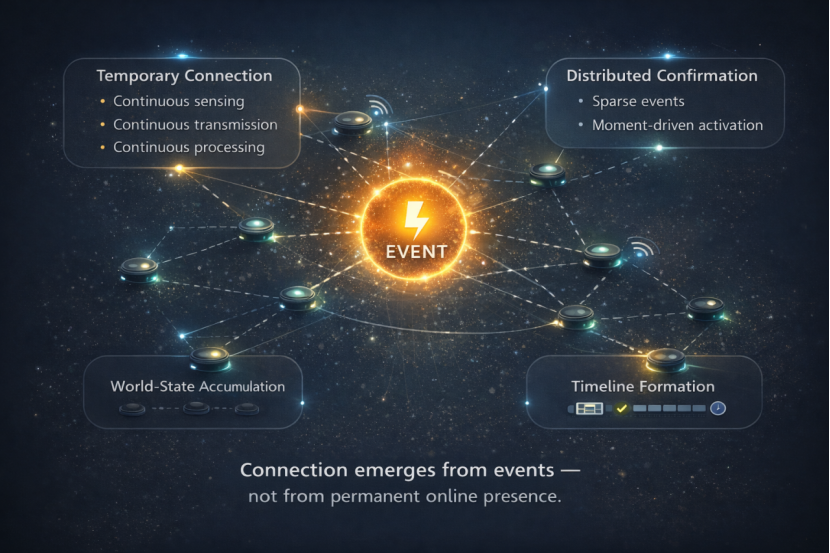
Second, it does not rely on being always online. The system evolves through long-term event accumulation rather than real-time high-compute operation.
Third, greater scale makes the system more stable. The more dolls exist, the more complete the world history becomes, and the more reliable system judgments are.
The long-term value of the swarm-style decentralized event system does not depend on sales of a single generation of dolls, but on how much history and how many rules the world accumulates.
This means the platform has “increasing returns with usage,” rather than ending after a one-time sale.
The swarm-style decentralized event system is a system where multiple dolls coexist in the same “world.”
Even if each doll is asleep or offline most of the time, the world continues to operate and evolve.
Trend dolls represented by Labubu have reached millions of units sold, proving the doll market is real.
But the business model of most trend dolls is primarily one-time sales:
This project does not deny that success. Instead, it extends the thinking:
Can a doll become a “persistent character,” not just a collectible object?
The innovation is not more complex hardware—it is a fundamentally different system approach:
As a result:
Dolls can sleep, but the world persists; users don’t just own a doll—they participate in a world.
Ordinary toys / AI toys focus on: “How smart is one toy?”
The swarm-style decentralized event system focuses on: “Can a world exist long-term and keep evolving?”
This difference is not a feature upgrade—it is a paradigm difference, and the cost to replicate is extremely high.
This enables low power, high stability, and long-term operability.
Company entity: xHuman Ltd
The core value of the swarm-style decentralized event system is not contained in any single codebase, any single algorithm implementation, or any single hardware form factor, but in the following inseparable system-level assets:
The purpose of this chapter is to clarify and solidify in advance the following key questions:
As of the submission date of this investment plan, the company has completed the following patent layout:
China (3 filings) 2026100001670, 2026100553835, 202620052673X
Canada (1 filing) 3297390 (platform system-related invention patent)
All of the above patents and derivative rights constitute the company’s background IP and will not be transferred or jointly owned due to any partnership relationship.
China: xHuman logo trademark.
All trademarks, brand identifiers, and derivative rights shall not be transferred, jointly owned, or implicitly licensed due to technical cooperation, joint development, or investment.
Core IP includes, but is not limited to:
📌 Core IP is defined by “system structure and rules,” not by any specific code implementation.
📌 This ownership principle is a prerequisite for “equity-for-technology / contribution-for-equity” models.
What is being valued is the contribution, risk-sharing, and commitment—not the purchase of code, system, or IP usage rights.
Under this model, all development outputs are treated as capital contributions to the company; IP is owned by the company; partner rights are reflected through equity—not through any form of IP carve-out or license split.
This clause distinguishes: “strategic technology contribution for equity” ≠ “outsourced development + implicit licensing.”
Any follow-on patents based on the swarm-style decentralized event system, its mechanisms, or core-role definitions shall be filed in the company’s name.
Partners may be listed as inventors where legally applicable, but not as patent owners or co-owners.
IP focus areas include:
The IP strategy for the swarm-style decentralized event system is not designed to maximize short-term collaboration convenience, but to ensure the system paradigm and platform value are not split, copied, or diluted over the long run. Partners participate in platform growth through equity, not by splitting the system to obtain partial control.
Fundraising target: CAD 500,000 (CAD 100,000 for exclusive provincial agency rights; no equity)
Equity offered: 5%
Funds will primarily be used for:
The founder will cover any shortfall in the first stage.
The project has completed its legal and technical foundations and is in an executable—not conceptual—stage.
The value of this round is:
The swarm-style decentralized event system is not a toy project that ends after sales—it is a doll-world system that can keep growing. We hope to work with investors who understand long-term value to advance this platform together.
